

Last updated: 16 October 2026 | Written by Pubudu Dissanayaka, founder of CeylonFarer
Table Of Content
- What is a Sri Lanka tuk tuk, and what are you hiring?
- What a Sri Lanka tuk tuk is not
- Can tourists drive a tuk tuk in Sri Lanka? The licence question
- Which licence class a Sri Lanka tuk tuk needs
- Three legal routes to a licence, and what each costs
- What do you need to hire a Sri Lanka tuk tuk?
- What does a Sri Lanka tuk tuk rental price actually include?
- What the Sri Lanka tuk tuk deposit actually is, and when you get it back
- What is Sri Lanka tuk tuk insurance actually covering?
- The excess, the damage list and the honest gap
- What should a Colombo tuk tuk fare be?
- When to negotiate, and when to walk away
- What does Sri Lanka tuk tuk fuel cost, and how far does a tank go?
- Where can you actually take one?
- The roads that are off limits
- Hill country in a Sri Lanka tuk tuk
- What do first-time tuk tuk drivers get wrong?
- Do you need an app instead of a hire?
- What we could not verify
- Frequently asked questions
- Can tourists drive a tuk tuk in Sri Lanka?
- How much does it cost to hire a tuk tuk in Sri Lanka?
- Do I need an International Driving Permit for a tuk tuk?
- What is a fair tuk tuk fare from Colombo airport to the city?
- Is it cheaper to hire a tuk tuk or a car with a driver?
- Can you drive a tuk tuk on the Sri Lankan expressways?
- What happens if I damage the tuk tuk?
- Is it safe to drive a tuk tuk in Sri Lanka?
- What fuel does a tuk tuk use and how far does a tank go?
- Do Colombo tuk tuks have meters?
- Where these numbers come from
- Where to go next
A Sri Lanka tuk tuk is the cheapest way to move around this island with your own set of wheels, and it is also the vehicle most visitors get wrong. The hire itself costs less than people expect. The licence does not.
Three-wheelers here are ordinary, working vehicles: they carry school runs, market loads and tourists, usually in the same afternoon. Hire one and you join that traffic rather than watch it from a bus window.
This guide answers the questions we get asked most about a Sri Lanka tuk tuk: who is allowed to drive one, what the licence costs on each legal route, what a rental price includes, what the insurance excess really is, what a fair fare looks like, and where three wheels cannot go. Every figure below is dated and traced to a source we opened on 21 September 2026, and the fuel prices were re-checked on 16 October 2026.
What is a Sri Lanka tuk tuk, and what are you hiring?
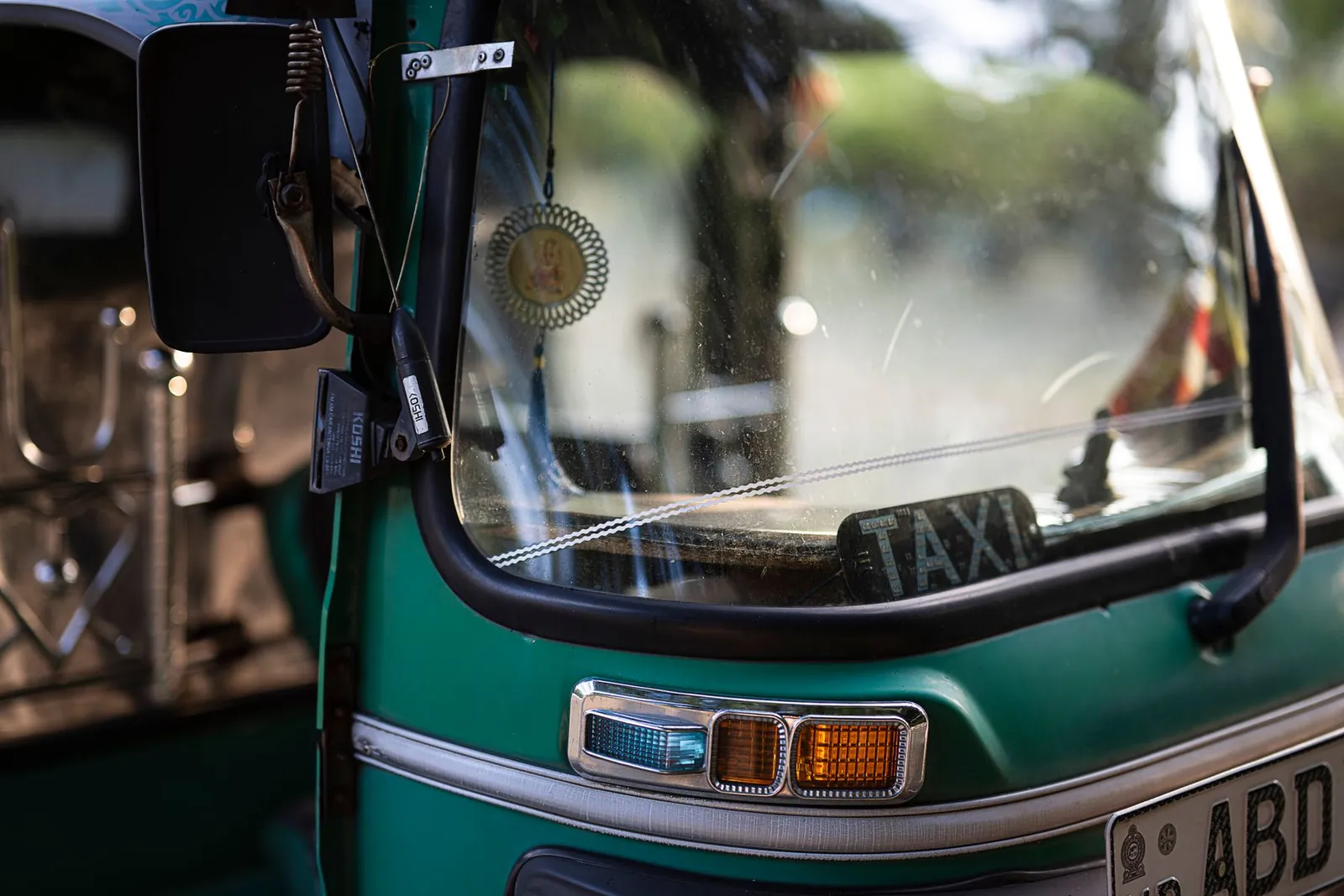
The local name people actually use in English is tuk tuk, and the vehicle is a three-wheeler: one front wheel, two at the back, an open-sided cabin with a soft top and a small petrol engine. In the Sinhala and Tamil the same machine is a three-wheeler, and on the road it is everywhere.
Nearly every Sri Lanka tuk tuk you can hire is a four-stroke Bajaj RE or a close copy, with a manual four-speed gearbox, a bench seat behind the rider and a compartment that swallows two backpacks. The soft top rolls up, which is why the view is so good.
Two details matter before you book a Sri Lanka tuk tuk. First, a Sri Lanka tuk tuk is slow: on a straight road you will sit around 40 to 50 km/h, and a fast main road is a long day. Second, this is a motorcycle-derived machine with three wheels and no airbags, so a hire only makes sense if you are comfortable in unsheltered traffic.
What a Sri Lanka tuk tuk is not
It is not an Indian auto, and it is not the Bangkok tuk tuk with a 125cc two-stroke engine and a price you agree on the pavement. Sri Lankan hire machines are four-stroke, and they are rented with paperwork. You also get an official holiday vehicle rather than a taxi you drive, which is why the licence question below matters so much.
Can tourists drive a tuk tuk in Sri Lanka? The licence question
Yes, if your Sri Lankan licence covers the three-wheeler class, which is the rule that decides whether you can drive a Sri Lanka tuk tuk at all. Your own country’s licence, or an ordinary car entitlement on an International Driving Permit, is not enough on its own: tuk tuk driving licence sri lanka rules run through a local endorsement, and the three-wheeler is a class of its own.
That single sentence explains most of the confusion online. Visitors read that the airport issues a temporary licence and assume it covers any Sri Lanka tuk tuk with an engine. It does not cover everything: the counter’s own conditions say the conversion is applied for motorcycle and light vehicle classes only.
Which licence class a Sri Lanka tuk tuk needs
The Department of Motor Traffic lists class B1 as the motor tricycle class. Its page cites section 122 of the Motor Traffic Act as amended by Act No. 08 of 2009, and describes B1 as a motor tricycle or van with a tare weight up to 500 kg and a gross vehicle weight up to 1,000 kg.
A dual purpose car, the class most visitors hold, is class B. Those are different lines on the same table, which is why a car conversion does not automatically put you on three wheels. When you book, the question to ask is plain: does my licence carry the B1 endorsement for this vehicle?
Three legal routes to a licence, and what each costs
There are three routes in practice, and they differ by more than a factor of ten in cost. The table below puts them side by side. Route A is the Department of Motor Traffic counter at Bandaranaike International Airport, which sits on the Arrival Walkway next to the supermarket for exactly this purpose.
| Route | Where | What you pay | How long |
|---|---|---|---|
| A. Temporary licence at the airport counter | BIA arrivals, Arrival Walkway (DMT desk) | LKR 45,000 for a person who is not a Sri Lankan citizen, plus the cost of a certified translation if your licence is not in English | Applied for on arrival; maximum validity five months |
| B. Endorsed IDP, then your own local licence | Automobile Association in Colombo | LKR 7,572.50, about US$21, plus the cost of an IDP carrying a Type B endorsement | About four hours of counter time |
| C. Rental operator orders it for you | Handled by the rental company | US$40 as a published option, or included in the package depending on the operator | One business day after you supply documents |
Route A is the fast, expensive path to driving a Sri Lanka tuk tuk legally, and its published fee list is worth reading before you fly. Issuing the licence to a person who is not a citizen is LKR 45,000, renewing it is LKR 15,000, a replacement for a lost licence is LKR 30,000, and the conversion of a citizen’s foreign licence is priced higher still, at LKR 60,000.
One honest wrinkle: the Department of Motor Traffic levy regulations, incorporating amendments up to 17 November 2025, price the foreign-licence issue at LKR 30,000 on a line that reads as the citizen rate. The counter list and the regulation schedule do not line up exactly, so treat LKR 45,000 as the planning number and confirm it at the desk.
Route B is the cheap one, and it is the route most long-stay riders use. An IDP with a Type B endorsement opens the Automobile Association counter in Colombo, which the rental operator we checked prices at LKR 7,572.50, roughly US$21 and about four hours of your day. If your IDP came without the Type B line, this route closes.
Route C is what most short-trip renters of a Sri Lanka tuk tuk actually do, whether they realise it or not. The local licence arrives with the vehicle, ordered by the operator for a published US$40, and the only work you do is sending a photograph of your passport and home licence.

What do you need to hire a Sri Lanka tuk tuk?
For most Sri Lanka tuk tuk hire bookings the list is short, and the operator carries the awkward part. Every tuk tuk hire sri lanka company we looked at wanted the same handful of documents. What you need in hand is a full driving licence from home, valid for at least a year; a passport and a Sri Lankan visa or entry permit; the fee or the deposit; and enough command of English or a translation to handle the paperwork.
- A full driving licence, held for at least a year, not a provisional or learner permit. The airport desk publishes that restriction explicitly.
- A certified English translation if your licence is not printed in English.
- Passport and visa, or an entry permit.
- A refundable deposit, published at US$150 on the operator we checked.
- About an hour of patience for the handover, including the driving lesson most operators insist on.
Age is worth asking about when you book rather than at the counter. The published rules we could read set driving licence thresholds for Sri Lankan classes, and operator terms vary, so a 20-year-old and a 70-year-old may get different answers from different companies. Put the question to the Sri Lanka tuk tuk operator in the booking email.
What does a Sri Lanka tuk tuk rental price actually include?
The headline day rate on a Sri Lanka tuk tuk tells you almost nothing, because the same machine costs 38 per cent less per day if you keep it a fortnight. The rate ladder below is the published table of the operator that ranks first for this term, checked on 21 September 2026, and it is the clearest pricing we have found anywhere.
| Vehicle | 0-13 days | 14-22 days | 23-38 days | 39-55 days | 56-365 days | Deposit |
|---|---|---|---|---|---|---|
| Standard four-stroke tuk tuk (manual) | $24 | $22 | $20 | $18 | $16 | $150 |
| Convertible or cabrio model (manual) | $26 | $24 | $22 | $20 | $18 | $150 |
| Electric conversion (automatic) | $28 | $26 | $24 | $22 | $20 | $150 |
| Driver-assisted trip, with a local driver | $45 | $45 | $45 | $45 | $45 | $150 |
Read that table twice, because the shape of it is the argument. Two weeks of Sri Lanka tuk tuk hire costs $22 a day rather than $24, and two months drops it to $18 or $16. Long rentals are where the tuk tuk rental sri lanka price becomes genuinely cheap.
The inclusion list matters as much as the number. On the operator we checked, the Sri Lanka tuk tuk rate carries unlimited kilometres, standard motor insurance subject to an excess, a driving lesson until you are confident, repairs on the road, a travel kit, and drop-off anywhere on the island. Hotel delivery is priced: free at the airport and Negombo, $15 to Colombo city, and up to $186 to Jaffna.
What the Sri Lanka tuk tuk deposit actually is, and when you get it back
The deposit is US$150 on every Sri Lanka tuk tuk in that table, held rather than spent, and refunded digitally by PayPal or card after the vehicle comes back undamaged. Three weeks of hire costs about $460 at the $22 rate. So the deposit is roughly a third of a fortnight’s rental, and worth planning for as cash flow rather than as a fee.
What is Sri Lanka tuk tuk insurance actually covering?
Tuk tuk insurance sri lanka rentals carry is real but thin, and the number that decides everything is the excess. The operator we checked publishes standard motor insurance with an excess of US$150, which means the first $150 of any damage claim is yours. Above that, the policy answers.
Two questions do more work here than any comparison table. Does the policy cover damage to the tuk tuk itself, not only the third party? And what is excluded, in writing, on the sheet you sign at handover? We have seen operators quote insurance without stating either, which is why the excess is the figure to hunt for.
The excess, the damage list and the honest gap
Before you ride off in a Sri Lanka tuk tuk, walk the vehicle with the handover sheet and photograph every scratch, dent and cracked mirror from two angles. That five minutes protects the deposit, because the argument at return is always about what was already there.
What we cannot give you is a single legal insurance rule that applies to every hire, because the cover sits inside private rental agreements rather than in one published government document. Ask for the policy wording before you pay, and treat any operator who cannot produce it as a reason to walk.
What should a Colombo tuk tuk fare be?
A Colombo tuk tuk fare follows a published scale, and knowing the numbers is the difference between a fair price and a tourist price. The last revision we can source is the Western Province Road Passenger Transport Authority’s, effective 24 March 2026, at Rs 110 for the first kilometre and Rs 90 for each kilometre after that.
Run that scale over the journeys you will actually take, and the arithmetic is simple. Our table below applies the gazetted rates, so you can sanity check any quote on the pavement before you get in.
| Journey | Distance | Metered total at the gazetted scale |
|---|---|---|
| Fort station to Pettah market | 3 km | Rs 290 |
| Galle Face to the National Museum | 5 km | Rs 470 |
| Fort to Mount Lavinia | 10 km | Rs 920 |
| Bandaranaike airport to Colombo Fort | About 32 km | Rs 2,900 |
When to negotiate, and when to walk away
In practice a metered tuk tuk is still the exception rather than the rule, and most drivers quote a price before you sit down. That is not automatically a scam: it is how the trade works outside the app era. The trick is to hold the scale above in your head, agree the number before you move, and offer the meter if the quote on your Sri Lanka tuk tuk looks wild.
Night rides, rain and luggage all push a quote up honestly. Two things do not. A driver who will not name a price before departure, and a driver who adds a second passenger to a fare you already agreed. Walk from both, because there is always another three-wheeler fifty metres away.

What does Sri Lanka tuk tuk fuel cost, and how far does a tank go?
Fuel is the cheapest part of running a Sri Lanka tuk tuk, and the Sri Lanka tuk tuk pump price is published by the state refinery rather than guessed. Lanka Petrol 92 is Rs 414.00 a litre under the revision that took effect on 30 September 2026, which is the grade a four-stroke three-wheeler drinks.
| Fuel grade | Price per litre | In force from |
|---|---|---|
| Lanka Petrol 92 Octane | Rs 414.00 | 30 September 2026 |
| Lanka Petrol 95 Octane | Rs 475.00 | 30 August 2026 |
| Lanka Auto Diesel | Rs 392.00 | 30 September 2026 |
Ceypetco’s live price table would not load when we re-checked it on 16 October 2026, so the figures above are taken from the corporation’s published revision of 30 September 2026 as carried by Newswire and Onlanka.
Distance is the harder half. We could not find an official fuel consumption figure for a Bajaj RE, so the table below uses three planning rates and you pick the one your own riding matches. Sensible riders on flat coastal roads sit at the top of the range; hill country and a heavy right hand sit at the bottom.
| Consumption | Cost per kilometre | Cost per 100 km | Cost per 1,000 km |
|---|---|---|---|
| 30 km per litre | Rs 13.80 | Rs 1,380 | Rs 13,800 |
| 35 km per litre | Rs 11.83 | Rs 1,183 | Rs 11,830 |
| 40 km per litre | Rs 10.35 | Rs 1,035 | Rs 10,350 |
That middle line is the important one. A thousand kilometres in a Sri Lanka tuk tuk costs roughly US$36 in petrol, which is less than two days of the hire itself. Fuel is not the reason to skip a tuk tuk hire, and any operator who bundles fuel into the day rate is charging you for convenience.
Where can you actually take one?
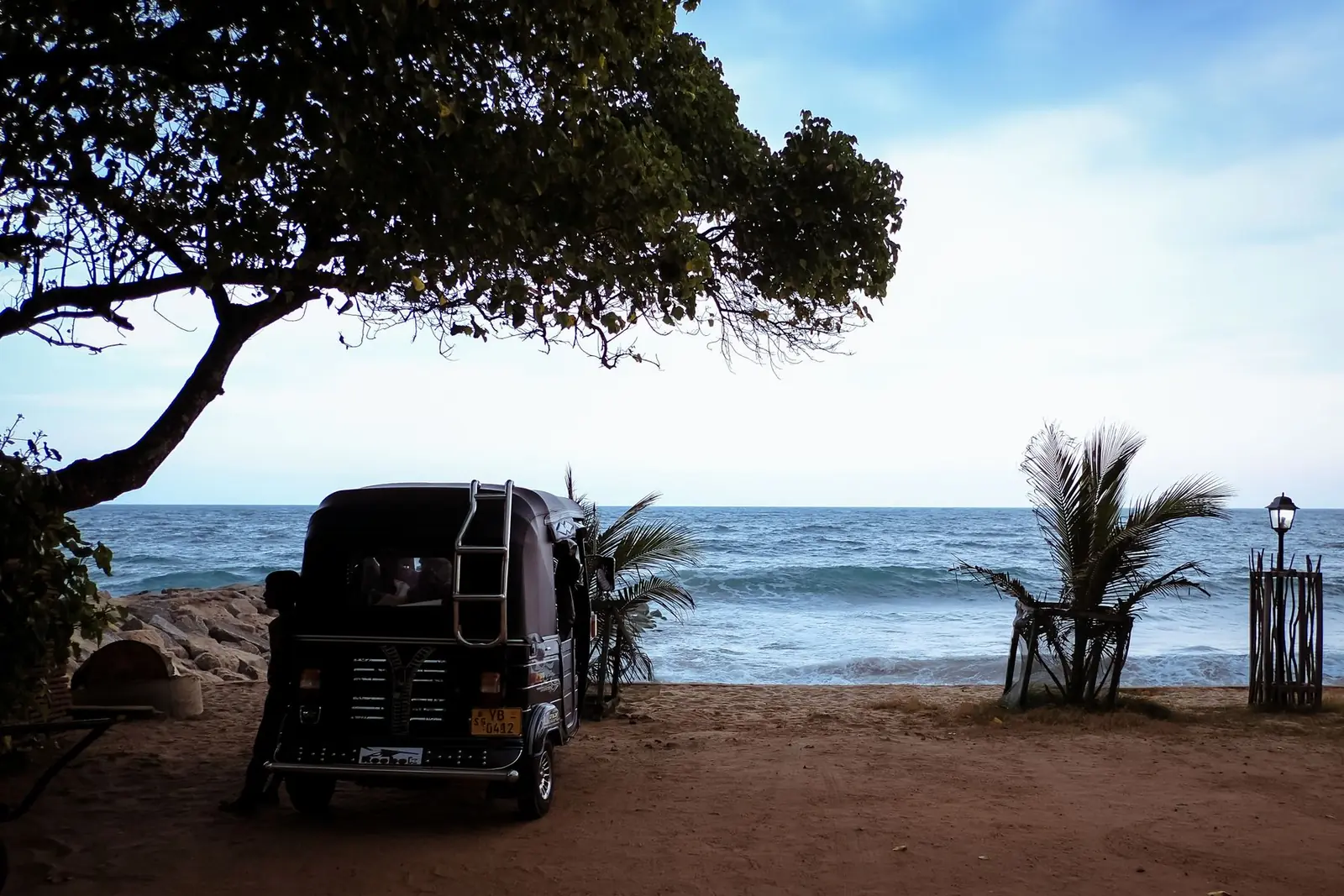
Almost everywhere except the fastest road on the island, and a Sri Lanka tuk tuk gets to far more of it than most visitors expect. A tuk tuk will happily run the coast from Negombo to Galle, climb to Kandy and Ella, and thread through the Cultural Triangle. What it cannot do is use the expressway network, and that single restriction reshapes a trip.
The roads that are off limits
The Road Development Authority’s own expressway user guide is unambiguous: three-wheelers, tuk tuks included, are strictly prohibited from entering the expressway, along with pedestrians, motorcycles, tractors and bicycles.
So the Southern Expressway shortcut from Colombo to Galle is not available to you. You take the coast road instead, which is slower, prettier and the reason people hire these machines in the first place. Plan the coast as a two-day run rather than an afternoon, and the restriction stops being a problem.
Hill country in a Sri Lanka tuk tuk
The tea country is where a Sri Lanka tuk tuk earns its reputation and where it hurts most. A 250cc three-wheeler with two people and luggage climbs the Kandy to Nuwara Eliya road slowly, in second gear for long stretches, and the hairpins are relentless.
None of that is a reason to avoid it. It is a reason to plan shorter days, to leave before eight in the morning, and to accept that the misty afternoon at 1,800 metres is cold enough for a jacket. Our train guide covers the hill country routes if you would rather ride the rails for that leg.

What do first-time tuk tuk drivers get wrong?
Five mistakes account for almost every unhappy Sri Lanka tuk tuk hire we hear about, and four of them are avoidable before you turn the key.
- Booking the whole island into ten days. Three wheels cover 200 to 250 km comfortably in a day, not 400.
- Assuming an expressway exists for you. It does not, so recalculate every long transfer.
- Skipping the handover lesson to save an hour, then meeting a lorry on the wrong side of a blind corner.
- Driving after dark on unfamiliar roads where dogs, unlit lorries and cyclists share your lane.
- Leaving the deposit question until the last morning, when every scratch becomes an argument.
Traffic in Sri Lanka moves on the left, overtaking happens on the right, and the horn is a courtesy rather than an insult. A short toot before a blind bend is not aggression here. It is how the road talks.
Rain is the one thing you cannot plan around. The south-west monsoon soaks the west and south coasts from May to September, and the north-east monsoon takes over the other half of the island from October. An open-sided cabin in a tropical downpour is wet, so check the season before you commit to a long riding route.
Do you need an app instead of a hire?
If you only want a few short trips, an app beats a hire, and Sri Lanka has a good local one. PickMe is a locally built platform and describes itself as the country’s top app for ride-hailing, with three-wheelers inside it, which makes it the first app to install rather than the taxi app you used at home.
Apps solve the negotiation problem, price the trip before you get in, and mostly work in Colombo, Kandy and the southern coast. Outside those areas coverage thins and a street tuk tuk wins. For a fortnight of independent travel in a Sri Lanka tuk tuk, apps and a hire are not alternatives: most riders use the app in the city and the hire for everything between towns.

What we could not verify
We could not find a Department of Motor Traffic page that states in plain English whether the temporary licence issued at Bandaranaike International Airport lets a visitor drive a Sri Lanka tuk tuk carrying the B1 tricycle endorsement. The counter’s conditions say motorcycle and light vehicle classes, so the safe reading is that you confirm it at the desk or let the operator supply the endorsement.
We could not verify Uber’s current three-wheeler coverage in Sri Lanka, so we have not recommended it. We could not find a fleet-wide official figure for the fuel consumption of a Bajaj RE, which is why the cost table above shows three planning rates instead of one number. We also could not source a national, current three-wheeler fare gazette covering provinces outside the Western Province, so treat the fare table as the scale we can evidence rather than a rule for the whole island.
Finally, the airport counter’s fee list and the DMT levy regulations disagree by LKR 15,000 on the conversion line. That is a gap between two official publications, and we have reported it rather than smoothed it over.
Frequently asked questions
Below are the ten questions we are asked most often about hiring and driving three-wheelers here, answered briefly and dated to the sources in the next section. If your question is about routes rather than rules, our transport hub maps the whole set of options, and the itinerary guide sequences them by trip length.
-
Can tourists drive a tuk tuk in Sri Lanka?
Yes, provided your licence carries the three-wheeler class. Sri Lanka’s class B1 is the motor tricycle class, and the conversion issued at the airport is applied for motorcycle and light vehicle classes only. Either confirm your endorsement covers B1, or let the rental operator supply one, which most published operators do as a US$40 option.
-
How much does it cost to hire a tuk tuk in Sri Lanka?
US$24 a day for a standard four-stroke three-wheeler on a short hire, falling to US$22 a day from day 14 and US$16 a day beyond 56 days, plus a refundable US$150 deposit. Driver-assisted hire, where a local drives you, is priced flat at US$45 a day. Those are the published rates of the operator we checked in September 2026.
-
Do I need an International Driving Permit for a tuk tuk?
Not for the airport conversion, which needs your full national licence valid for at least a year and a certified English translation if it is not in English. An IDP with a Type B endorsement is what opens the cheaper Automobile Association route in Colombo, priced at LKR 7,572.50, about US$21.
-
What is a fair tuk tuk fare from Colombo airport to the city?
The run into Colombo Fort is about 32 km. On the gazetted Western Province scale of Rs 110 for the first kilometre and Rs 90 afterwards, that works out to roughly Rs 2,900. Street drivers at the airport quote more, especially after midnight, so agree the number before you load your bags.
-
Is it cheaper to hire a tuk tuk or a car with a driver?
Self-drive three-wheeler hire wins on cost for one or two travellers: about US$22 a day plus roughly US$36 of fuel for 1,000 km. A car with a driver costs several times that because you are buying the driver’s day as well. For four people with luggage, the car usually wins on comfort per rupee.
-
Can you drive a tuk tuk on the Sri Lankan expressways?
No. The Road Development Authority lists three-wheelers among the vehicles strictly prohibited from entering the expressway, along with motorcycles, tractors, pedestrians and bicycles. Every long transfer has to use the A and B roads, which is why the Colombo to Galle run takes a full day rather than two hours.
-
What happens if I damage the tuk tuk?
Standard rental insurance carries an excess, published at US$150 on the operator we checked, so the first US$150 of damage is yours to cover and the policy answers above that. Photograph every existing scratch on the Sri Lanka tuk tuk at handover and keep the images until your deposit is refunded, which is done digitally by card or PayPal.
-
Is it safe to drive a tuk tuk in Sri Lanka?
It is safe enough for the tens of thousands of visitors who do it, on the same terms as riding a scooter: left-hand traffic, no crash protection, and buses that assume you will move. The riskiest habit is riding after dark in rain. Plan short daylight days, avoid the expressway ban problem by planning routes properly, and it is manageable.
-
What fuel does a tuk tuk use and how far does a tank go?
Four-stroke three-wheelers run on Lanka Petrol 92, priced at Rs 414.00 a litre in the revision effective 30 September 2026. At 35 km per litre that is about Rs 11.83 per kilometre. Most hire machines carry roughly eight litres, so plan on refuelling about every 250 to 280 km, and fill up in towns rather than on the hill roads.
-
Do Colombo tuk tuks have meters?
Some do, and many do not. Where a meter exists the gazetted scale applies: Rs 110 for the first kilometre and Rs 90 for each one after. Where it does not, the driver quotes a price and you agree it before departure. Apps such as PickMe fix the price in advance, which is why they are worth having installed even if you hire your own three-wheeler.
Where these numbers come from
- Temporary licence conditions, classes and the fee list at Bandaranaike International Airport: airport.lk driving services, read 21 September 2026.
- Licence classes, including B1 as the motor tricycle class, and the levy schedule: Department of Motor Traffic vehicle classes, read 21 September 2026.
- Pump prices and the date each revision took effect: Ceylon Petroleum Corporation fuel price archive – revision effective 30 September 2026. The corporation’s live price table would not load on 16 October 2026, so the revision was read from Newswire and Onlanka.
- Three-wheeler fares for the first kilometre and beyond: News 1st report on the fare revision, 23 March 2026.
- Vehicles banned from the expressways: Road Development Authority expressway user guide, read 21 September 2026.
- Rental rate ladder, deposit, insurance excess and licence options: tuktukrental.com published pricing, read 21 September 2026.
Every figure in this article is either from one of those pages or is our own arithmetic, and each table says which. Where a number could not be sourced, it is absent and the gap is named in the section above rather than filled with a guess.
Where to go next
If the licence question is settled, the next decision is the route. Our Sri Lanka transport hub compares trains, buses, three-wheelers and private drivers side by side, and the itinerary guide turns that into a day-by-day plan by trip length.
Two more pieces fit alongside this one. The train travel guide and our seat reservation walkthrough cover the legs where three wheels are the wrong choice, the money guide explains why you want small notes for fares and deposits, and the ETA visa guide sorts the paperwork that has to exist before any of this starts.
Check the month-by-month weather guide before you fix your riding dates, and if you would rather hand the driving to someone else, read the tour package guide first. For the city itself, where the metered alternative to a hired three-wheeler matters most, the Colombo transport guide covers the fares, the apps and the suburban rail. Questions about a specific hire go through the contact page.



No Comment! Be the first one.