


Last updated: 17 September 2026 | Written by Pubudu Dissanayaka, founder of CeylonFarer
Table Of Content
- What Sri Lanka train travel actually is
- The two booking systems behind Sri Lanka train booking
- Sri Lanka train classes, compared honestly
- The Colombo to Kandy train: leg one
- Kandy to Ella: the 151 km that everyone photographs
- Where to break the journey
- Nanu Oya, for Nuwara Eliya
- Haputale, for the ridge
- Ella, for everything else
- Kandy to Ella train booking: what exists, and when it opens
- The observation class train Sri Lanka Railways keeps at the back
- What a reserved seat adds to the fare
- The coast line, the northern line and the routes nobody mentions
- Collecting a reserved seat: counters and their real hours
- What tends to surprise first-time riders
- When the train is the wrong choice
- What we could not verify
- Frequently asked questions
- Is Sri Lanka train travel worth it compared with a private driver?
- How far ahead can I book a reserved seat?
- Do I need an account to use the official booking site?
- What happens if I cancel a reserved seat?
- Is the observation saloon worth the extra money?
- Which classes run on the hill country trains?
- How much is a train ticket from Colombo to Kandy?
- Can I buy a ticket on the train?
- Are the trains safe for solo travellers and families?
- What is the longest train journey in Sri Lanka?
- Where these numbers come from
- Where to go next
Sri Lanka train travel is the cheapest way to cross the island and the slowest, and most people happily take that trade. The railway runs on 19th-century alignments through tea country and along the coast, and a third-class seat from Colombo Fort to Kandy costs Rs 240 on the ordinary fare scale.
We take the fares below from Sri Lanka Railways’ own ticket-rate sheets and its own charge revision, so every rupee can be checked against the operator’s documents. Where a number is dated, we say so.
This guide follows the line the way you ride it: Colombo Fort first, then the climb to Kandy, then the hill country stretch everyone photographs. The booking rules come from the official reservation portal, which we read on 17 September 2026, and the classes come from the operator’s own service list.
What Sri Lanka train travel actually is
Sri Lanka Railways is a government department, and the network it runs has seven lines. The Main Line climbs from Colombo Fort to Badulla, 292.39 km of it, through Kandy and the tea districts. The Coast Line follows the sea south to Galle, Matara and Beliatta.
The Northern Line runs 395.83 km to Jaffna and Kankesanthurai, and two more lines cross the dry zone to Trincomalee and Batticaloa. Between them they cover almost every route Sri Lanka train travel is known for.
Two features shape every trip on Sri Lanka train travel. The first is that the hill country was built for tea, not for tourists: the operator’s own history notes that the alignment was fixed about 140 years ago to minimise cuttings and bridges, which left gradients of 2 to 3 per cent and very sharp curves. Hill country speeds are 25 to 40 kmph. Low country speeds reach 65 to 80 kmph.
The second is demand, and it is the reason Sri Lanka train travel needs a plan. Second and third class are almost always busy, the reserved seats on the popular hill services sell out days ahead, and nothing moves quickly. That is why Sri Lanka train travel rewards planning more than almost any other part of a trip here, and also why it still costs a fraction of a taxi.
- Main Line: Colombo Fort to Kandy, Nanu Oya, Ella and Badulla, and the Matale branch.
- Coast Line: Colombo Fort to Galle, Matara and Beliatta.
- Northern Line: Colombo Fort to Anuradhapura, Vavuniya and Jaffna, with the Talaimannar branch.
- East: the Trincomalee line and the Batticaloa line, both largely served by night mail trains.
- Short runs: the Kelani Valley line out of Colombo, the Puttalam line, and the Kandy to Matale rail car, all useful for short hops on Sri Lanka train travel.
The two booking systems behind Sri Lanka train booking
Almost every complaint about Sri Lanka train booking comes from mixing up two separate systems, and both of them are still real Sri Lanka train travel. The first is the ordinary counter sale: you turn up, pay a low fare, and take whatever space exists in your class. The second is seat reservation, which the operator runs through its own online portal at seatreservation.railway.gov.lk.
The reserved system is stricter than most travellers expect. You need an account on the portal, and the site states that a reservation must be made at least four days, or 96 hours, before departure. The confirmation is an e-ticket, and you collect the printed ticket at a station where the mTicketing service runs, with your NIC or passport at the counter. Miss that collection step and the seat is gone even though Sri Lanka train travel was paid for.
Cancelling has its own price list, and it is worth knowing before you book. More than 168 hours before departure, 75 per cent of the ticket fee comes back. Between 48 and 168 hours, 50 per cent comes back.
Under 48 hours, nothing does, and the service charge is never refunded. Cancellation is done in person at an mTicketing station, not online.
The operator also runs a smart ticketing system and season tickets for commuters, which tells you something useful: Sri Lanka train travel is a working transport network first. On a weekday morning you are sharing the carriage with people going to work and school. That is the version of Sri Lanka train travel most visitors never see.
Sri Lanka train classes, compared honestly
Sri Lanka train classes are not a ranking of comfort in the way travellers assume. First class is quiet, usually has two seats either side of the aisle, and on a few services it is air-conditioned. Second class is the standard local carriage.
Third class is the cheapest and the fullest, and on the hill lines it is the one where the doors stay open. Class choice is the first real decision in Sri Lanka train travel.
Prices for the ordinary, unreserved ticket come from the operator’s Colombo Fort rate sheet and rise with distance, not with the train’s speed. The table below is the row you actually need, with the distances the operator publishes alongside it. Use it as the base line for Sri Lanka train travel on any line in this guide.
| From Colombo Fort | Km | 1st class | 2nd class | 3rd class |
|---|---|---|---|---|
| Peradeniya Jnc | 114.85 | Rs 950 | Rs 500 | Rs 240 |
| Kandy | 120.74 | Rs 950 | Rs 500 | Rs 240 |
| Hatton | 174.91 | Rs 1,250 | Rs 650 | Rs 320 |
| Nanu Oya | 207.06 | Rs 1,450 | Rs 750 | Rs 360 |
| Haputale | 247.97 | Rs 1,600 | Rs 800 | Rs 400 |
| Bandarawela | 259.15 | Rs 1,650 | Rs 850 | Rs 420 |
| Ella | 271.59 | Rs 1,750 | Rs 900 | Rs 440 |
| Badulla | 292.39 | Rs 1,800 | Rs 900 | Rs 460 |
| Galle | 113.89 | Rs 950 | Rs 500 | Rs 240 |
| Matara | 156.82 | Rs 1,150 | Rs 600 | Rs 300 |
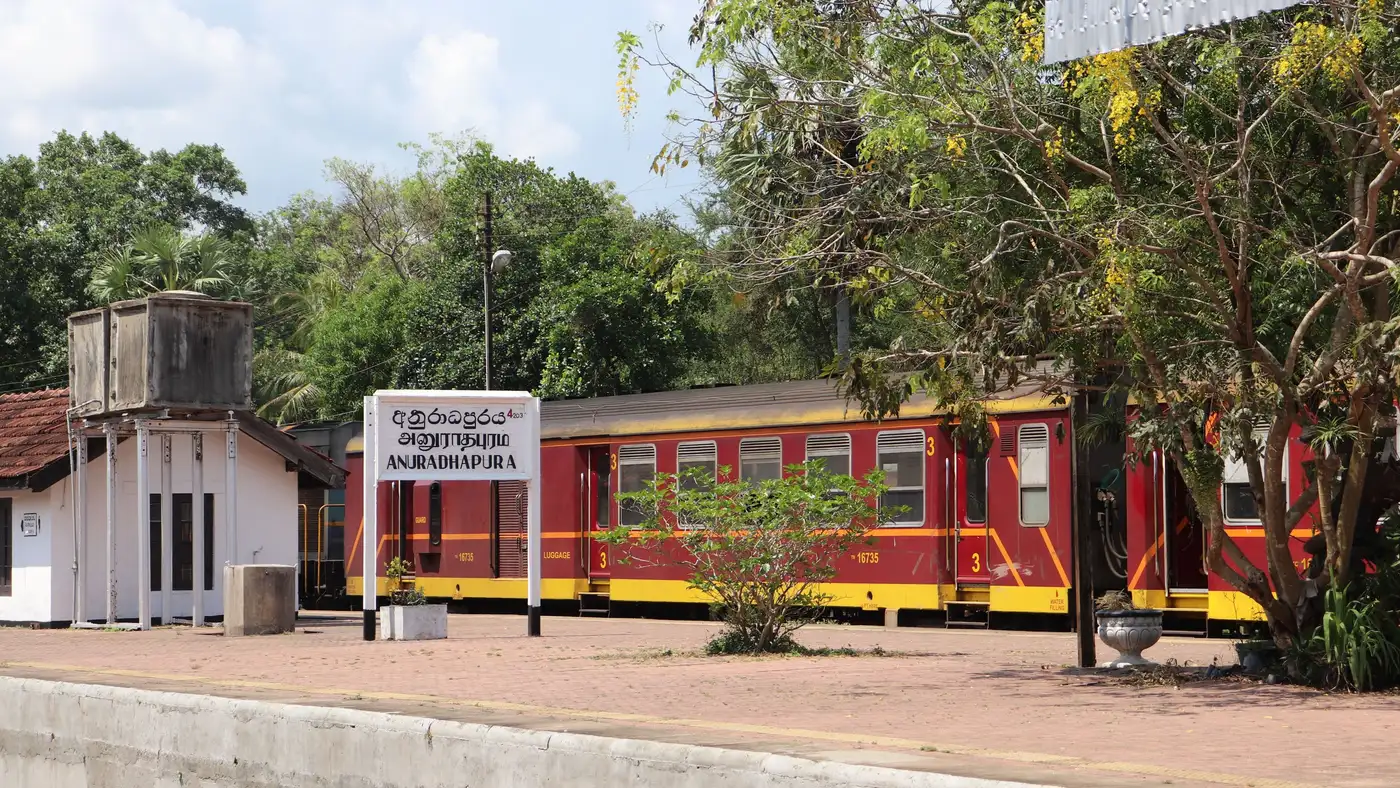
| Anuradhapura | 204.94 | Rs 1,450 | Rs 750 | Rs 360 |
| Jaffna | 395.83 | Rs 2,250 | Rs 1,150 | Rs 580 |
Read that table twice before you decide to fly to Jaffna. A third-class ticket to the far north costs less than a coffee in some of the hotels you will pass on the way. For Sri Lanka train travel on a budget, the ordinary fare is the whole story.
The Colombo to Kandy train: leg one
The Colombo to Kandy train is the busiest reserved route on the island, and it sets the pattern for everything after it. Fort to Kandy is 120.74 km and the operator lists Intercity and Express services on it with first, second, third and observation saloon classes. Fort to Badulla, the full length of the Main Line, carries the same four classes. If Sri Lanka train travel has one rule, it is to reserve this leg early.
There are three kinds of train on this leg and they feel different. The Intercity runs with fewer stops. The Express stops a little more, and the slow trains stop often enough that the journey becomes a local bus with better views.
If your time is short, take the Intercity and accept the slightly higher reserved fare.
Out of Fort the line is flat and suburban as far as Ragama, then the hills start at Rambukkana, 84.44 km out. Kadugannawa, at 105.54 km, is where the alignment starts to twist, and Peradeniya Junction at 114.85 km is where the Matale branch peels off. Kandy is six kilometres further on. Those distances are how you judge any claim about Sri Lanka train travel times.
The counter at Kandy opens at 03:30, which sounds absurd until you notice how many trains leave the hill capital before dawn. For Sri Lanka train travel in the hill country, an early start is not a virtue, it is the practical option. Nothing else in the timetable is as reliable as the first departure of the day.

Kandy to Ella: the 151 km that everyone photographs
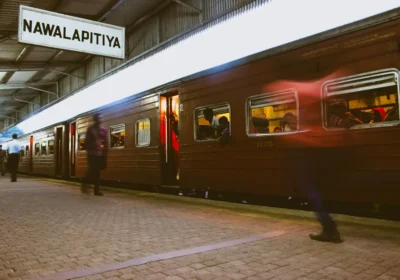
The climb from Kandy to Ella is 150.85 km, measured from the operator’s own distances, and it is the reason most people start reading about Sri Lanka train travel in the first place. The line leaves Kandy, drops to the Mahaweli valley, then climbs through Gampola, Nawalapitiya and Hatton into the tea belt.
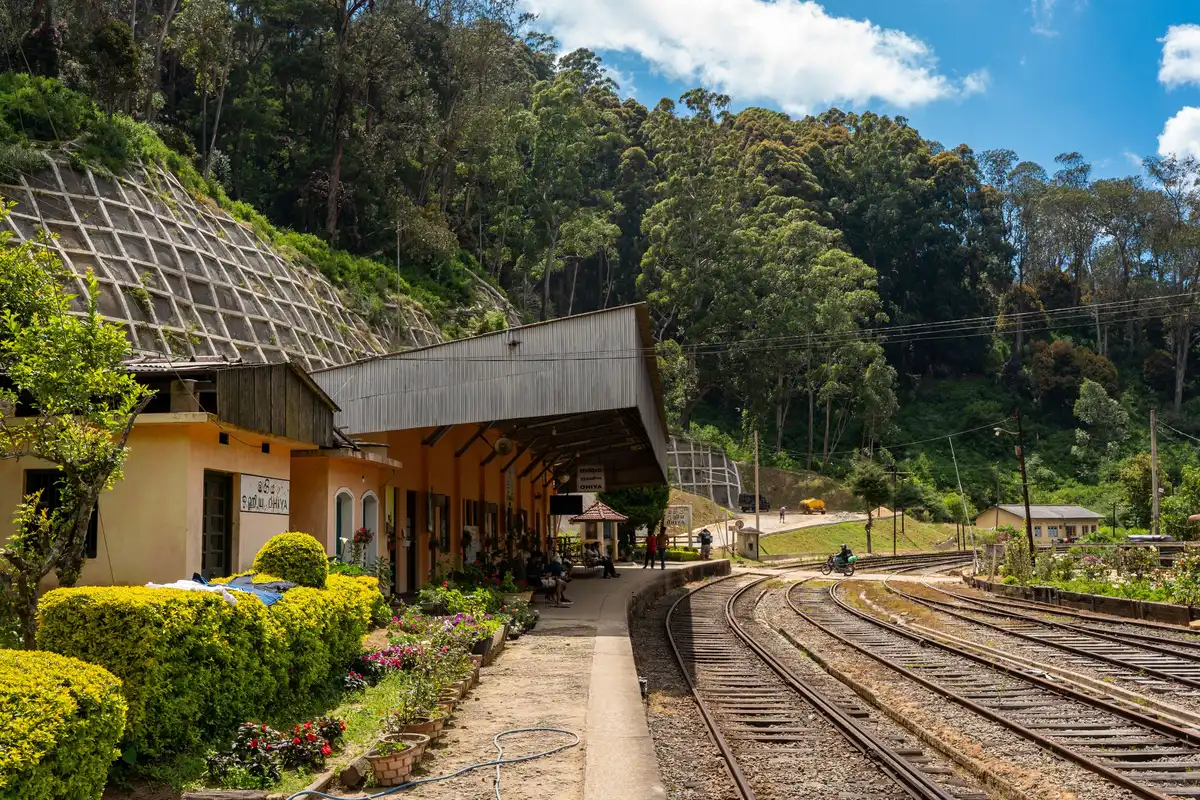
The stations come in a rhythm that tells the story. Nanu Oya at 207.06 km is the stop for Nuwara Eliya. Ambewela at 221.50 km and Pattipola at 224.93 km are the high, cold, wide-shouldered part of the route, close to the Horton Plains plateau. Ohiya at 231.64 km, Idalgashinna at 240.56 km and Haputale at 247.97 km follow the ridge line.
Then the descent: Bandarawela at 259.15 km, Ella at 271.59 km, Demodara at 277.72 km, Hali Ela at 286.60 km and Badulla at 292.39 km. Demodara is where the line loops back over itself, and the Nine Arch Bridge sits a short walk from the village.
Which side should you sit on? Sit on the valley side, and work out which side that is by watching which way the tea slopes away as you leave each station. On this line, in second and third class, the doorway matters more than the seat anyway, and nobody will move for you because the view is technically theirs. Advice like this is the part of Sri Lanka train travel no timetable can give you.
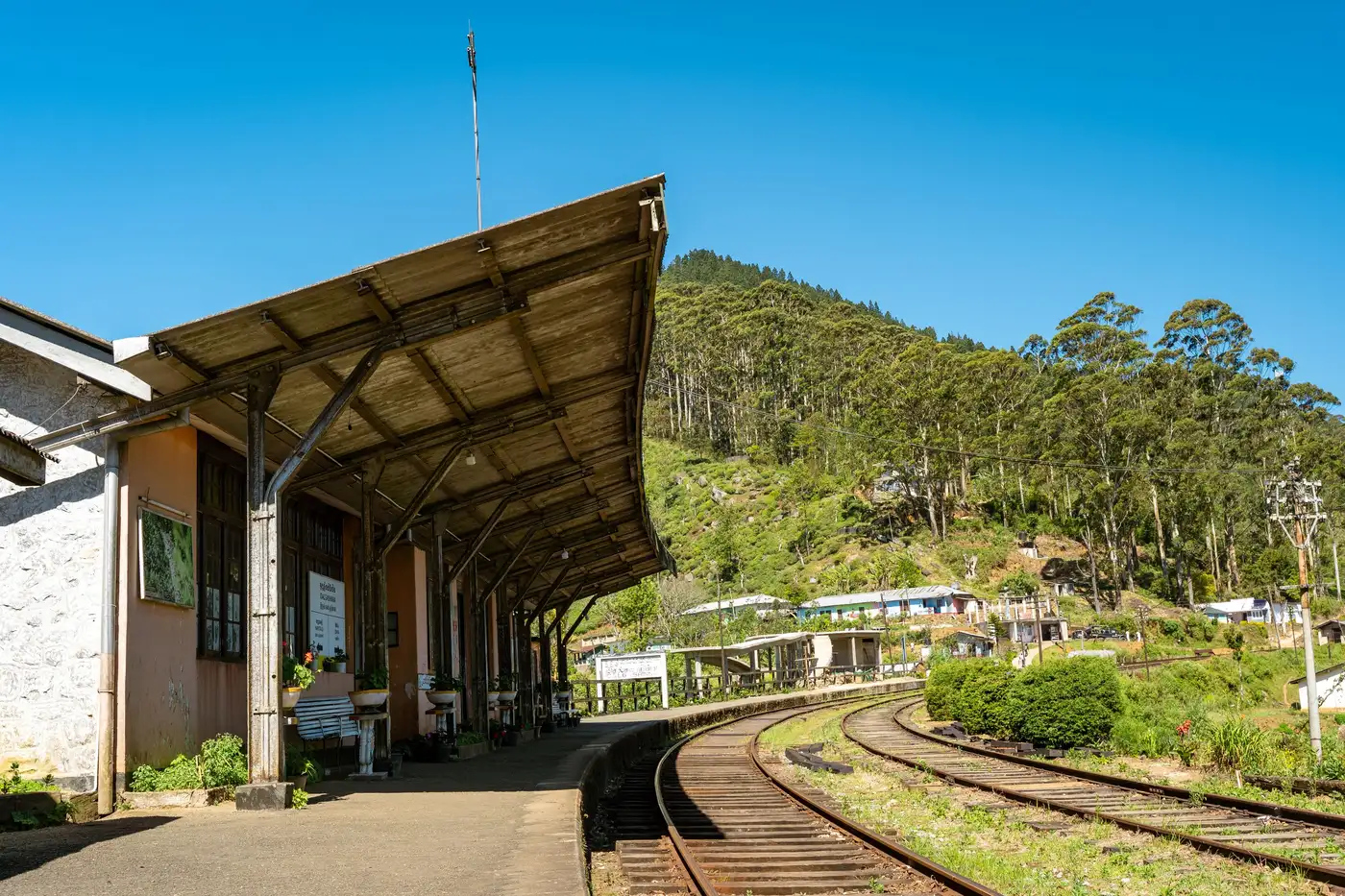
The stretch between Nanu Oya and Haputale is the one to protect. Do not book a train that arrives here after dark, and do not sleep through Idalgashinna.
Prices for the unreserved version of this ride are the ordinary fares in the first table: Rs 1,450 in first class, Rs 750 in second and Rs 360 in third from Fort to Nanu Oya. Sri Lanka train travel at this level of scenery for that money does not exist anywhere else on the island.

Where to break the journey
Most people ride the hill line in one go and regret it, because the good part is not a station, it is a series of them. Three breaks are worth the cost of a second ticket, and each one sits on the same line, so nothing is wasted. Breaking the journey is the single best upgrade to any Sri Lanka train travel plan.
Nanu Oya, for Nuwara Eliya
Nanu Oya is 207.06 km from Fort and the fare is Rs 1,450, Rs 750 or Rs 360 depending on class. The town of Nuwara Eliya is a short bus or tuk-tuk ride uphill. The station counter opens at 07:00 and closes at 23:00, and the reservation desk can be reached on 052-2222873, which is published by the operator itself.
Haputale, for the ridge
Haputale at 247.97 km costs Rs 1,600, Rs 800 or Rs 400. The counter stays open until 23:00, which matters if you arrive on a late train and need to buy an onward ticket for the morning. This is the quietest of the three stops and the one with the sharpest drop off the platform edge.
Ella, for everything else
Ella at 271.59 km is Rs 1,750, Rs 900 or Rs 440, and its counter runs from 06:00 to 21:30 with a reservation line on 057-2228571. Ella is busier than it looks on a map, so treat the seat as the thing you book first and the guesthouse as the thing you book second. This is the stop where Sri Lanka train travel turns into a queue if you leave it late.
- Break once, at Nanu Oya, if you want the tea estates and a cooler night.
- Break at Haputale if you want the ridge walk and empty platforms.
- Break at Ella if you want the bridge, the cafes and the easiest onward transport.
- Do not break at all three on one ticket; buy each leg separately and you keep your options.
Kandy to Ella train booking: what exists, and when it opens
Kandy to Ella train booking is where most trips are won or lost, because the reserved seats on this stretch are limited and the demand is not. The operator lists the Colombo Fort to Badulla services, which pass through both stations, with first, second, third and observation saloon classes available. The Kandy to Badulla slow train is listed with the observation saloon only. The rest of Sri Lanka train travel follows the same four-day rule.
Reserved seats are priced per journey rather than per kilometre, from the operator’s charge sheet. Kandy to Ella in second class is Rs 1,700, in third class Rs 1,200, and in first class Rs 2,500. Nanu Oya to Ella is Rs 1,200 in second class and Rs 900 in third, and Ella to Badulla is the same.
Three practical points follow. Book at least four days out, because the portal will not take a reservation inside 96 hours. Use a station with an mTicketing counter for collection, and take the passport the booking was made under.
If the online portal refuses your card, the station counters at Kandy, Nanu Oya and Ella all take reservations over the phone numbers published on the operator’s own list, and a hotel or driver can usually help you call. None of it is difficult, and it is the part of Sri Lanka train travel that repays an hour of preparation.
One warning we repeat every time we write about Sri Lanka train travel: do not buy a reserved seat from a stranger on a platform. The ticket is not transferable in practice, and the seat you paid for will be occupied by whoever holds the real reservation.
The observation class train Sri Lanka Railways keeps at the back
The observation class train Sri Lanka Railways attaches to certain hill services is a saloon carriage with a viewing end, and it is the reason some travellers pay three times the ordinary fare for the same rails. The operator’s service list shows observation saloons on the Fort to Kandy and Fort to Badulla services, both Intercity and Express, and on the Kandy to Badulla slow train.
It is not a luxury product. You sit in a reserved seat in a carriage built for looking out, and the fare is a reservation charge rather than a class upgrade. On the Main Line the sheet prices a reserved first-class seat from Fort to Ella at Rs 2,800 and a second-class reserved seat at Rs 1,800, and the saloon sits at the top of that scale.
The operator also runs named tourist services on the same line. The Ella Odyssey has its own published fare sheet, with a Fort to Ella first-class seat at Rs 5,000, Nanu Oya to Ella at Rs 4,000 in first class and Rs 2,000 in third, and Ella to Badulla at Rs 2,000 in first class and Rs 1,000 in third. A second named service, the Dunhinda Odyssey, appears on the operator’s own site as well.
Our view, after riding both: the observation saloon is worth it once, on the Nanu Oya to Ella stretch, and only in dry weather. In a monsoon downpour the glass is a disadvantage, and the open door of a third-class carriage is the better seat. That is a preference, not a rule, and Sri Lanka train travel has room for both.
What a reserved seat adds to the fare
The second table you need is the reservation charge, and it is a flat amount per journey rather than a per-kilometre rate. These figures come from the operator’s seat reservation revision, which took effect on 1 August 2022, and they are charged on top of nothing else: the reservation price is the whole price of that reserved seat. Nothing else is added, which is unusual for Sri Lanka train travel and worth knowing.
| Journey | 1st class | 2nd class | 3rd class |
|---|---|---|---|
| Fort to Kandy | Rs 2,000 | Rs 1,200 | Rs 900 |
| Fort to Nanu Oya | Rs 2,500 | Rs 1,700 | Rs 1,200 |
| Fort to Ella | Rs 2,800 | Rs 1,800 | Rs 1,300 |
| Fort to Badulla | Rs 3,000 | Rs 2,000 | Rs 1,500 |
| Kandy to Nanu Oya | Rs 2,000 | Rs 1,200 | Rs 900 |
| Kandy to Ella | Rs 2,500 | Rs 1,700 | Rs 1,200 |
| Kandy to Badulla | Rs 3,000 | Rs 1,800 | Rs 1,300 |
| Nanu Oya to Ella | Rs 2,000 | Rs 1,200 | Rs 900 |
| Ella to Badulla | Rs 2,000 | Rs 1,200 | Rs 900 |
Compare the two tables and the decision gets easy. A reserved third-class seat from Fort to Ella costs Rs 1,300, roughly three times the ordinary third-class fare of Rs 440. If the date is fixed, that is cheap insurance.
If you have three spare days in Colombo, the ordinary ticket is the better buy. That comparison is most of Sri Lanka train travel budgeting in one line.
The coast line, the northern line and the routes nobody mentions
The Coast Line south from Fort is the second-biggest part of Sri Lanka train travel and gets a fraction of the attention. Galle is 113.89 km away and costs Rs 950, Rs 500 or Rs 240. Matara is 156.82 km at Rs 1,150, Rs 600 or Rs 300, and Beliatta is 183.23 km at Rs 1,300, Rs 650 or Rs 340.
The Coast Line runs right against the sea for long stretches south of Kalutara, and the operator lists first, second and third class on the Fort to Beliatta services. Its counter hours are odd in useful ways, though. Beliatta’s ticket counter runs from 14:00 to 08:00, through the night.
Ambalangoda closes at 16:00, while Galle and Matara both work a normal day.
The Northern Line is where the country changes. Anuradhapura is 204.94 km away at Rs 1,450, Rs 750 or Rs 360, and the operator lists first, second and third class on the Intercity, Express and night mail services to Jaffna. Jaffna itself is 395.83 km from Fort at Rs 2,250, Rs 1,150 or Rs 580, which is the longest ride on the network. That is the Sri Lanka train travel most visitors never plan for.
Two eastern lines are worth knowing about. The night mail to Trincomalee, 296.91 km away, carries second and third class only, at Rs 950 and Rs 460. The Batticaloa line, 349.69 km, carries first, second and third at Rs 2,050, Rs 1,050 and Rs 520.
The Talaimannar night mail to the Mannar side is second class only. Each of these lines is Sri Lanka train travel at its least crowded.
If your plan includes any of these, our guide to getting around Sri Lanka covers the buses that run alongside them, and the itinerary guides show how a rail leg fits into a two-week route.
Collecting a reserved seat: counters and their real hours
A reserved seat is not a ticket until you collect it, and the collection happens at a station where the mTicketing service runs. The operator publishes the counter hours for every one of those stations, and a few of them will decide your day. Colombo Fort runs around the clock. Kandy opens at 03:30 and closes at 20:30, and collection is the step that trips up the most careful Sri Lanka train travel plans.
The hill country hours are generous in a way that surprises people who have only used the Colombo end. Nanu Oya runs 07:00 to 23:00. Haputale runs 06:00 to 23:00, Diyatalawa 06:00 to 22:30, Bandarawela 05:00 to 22:00 and Badulla 05:00 to 21:00. Ella closes earlier, at 21:30.
- Take the NIC or passport the reservation was made under, in person. Nobody can collect it for you.
- Collect before your travel day if you can, so a broken queue cannot cost you the train.
- Colombo Fort is the only counter that never closes, which makes it the safe place to fix a problem.
- Keep the printed ticket with you on the train; the checker walks the carriage, and the reference on your phone is not the ticket.
What tends to surprise first-time riders
Four things catch people out on their first long ride. The first is the temperature: Pattipola and Ambewela sit above 1,800 metres and the carriage is open, so a hill country morning is cold. Bring a layer even in April.
The second is luggage. There is no baggage car on these services in any practical sense, so your bag sits with you or above you. Travel light on the hill line and leave the big case in Colombo.
The third is food. Vendors board at the larger stations selling short eats, and there is no dining car on the ordinary services. The fourth is the reserved seat itself: if someone is sitting in it, show the printed ticket to the checker rather than starting an argument, and the checker will move them.
None of this is a reason to avoid the railway. It is a reason to treat Sri Lanka train travel the way you would treat a long-distance bus anywhere else: assume it will be slower than promised, and enjoy the part you cannot get on a road.
When the train is the wrong choice
Trains are not always the answer, and the operator’s own line speeds tell you why. At 25 to 40 kmph in the hill country, the train loses to a car over any distance under about two hours of driving, and it ties with the expressway buses on the Colombo to Galle run.
Book the train when the route is the point, which means the hill country above all. Take a road when you are covering ground: Colombo to the airport, a run down the expressway to Galle, or any day with three stops and a fixed arrival time. Mixing the two is the honest answer to most Sri Lanka train travel questions.
Buses are regulated separately from the railway, and the National Transport Commission publishes the bus side of the network at ntc.gov.lk if you want to compare. For a mixed trip, our transport hub sets the two against each other fare by fare.
What we could not verify
We did not publish departure or arrival times, and that is deliberate. The operator’s online schedule search did not respond when we tried it on 17 September 2026, so every timetable number you see elsewhere comes from a third party, and we will not copy one. An unsourced number is worse than no number in Sri Lanka train travel.
The reservation charges are dated 1 August 2022, and the ordinary fare sheets carry an effective-from line without a printed date on the copy we read. Treat both as current until the operator revises them, and check the counter price when you buy. Fares on Sri Lanka train travel have moved with the currency, and no third party knows the next revision.
Two smaller gaps. We could not confirm whether the Dunhinda Odyssey carries the same reservation scale as the Ella Odyssey, so no fares for it appear here. And the berth charges on the night mail services are listed in a way that mixes seat and berth columns, so we have left them out rather than guess which number belongs to which.
Frequently asked questions
These are the questions we get most often about Sri Lanka train travel, answered from the operator’s own documents. They come up in almost every email we get about the railway. Where the answer depends on a price or a rule, the source is named in the next section.
The short version: reserve the hill country, buy the rest over the counter, and give every journey more time than the timetable suggests. If you only take one train in Sri Lanka, take the one that climbs from Kandy towards Ella in daylight.
-
Is Sri Lanka train travel worth it compared with a private driver?
On the hill country line, yes. The scenery is the reason to travel, and a reserved second-class seat from Kandy to Ella costs Rs 1,700 against a driver day rate that runs several times higher. For a day with three stops and a fixed arrival time, a car wins.
-
How far ahead can I book a reserved seat?
The operator’s portal will not take a reservation inside four days, or 96 hours, of departure, so the practical window is from that point up to the day. Book as soon as your dates are fixed for the Fort to Kandy and Kandy to Ella services.
-
Do I need an account to use the official booking site?
Yes. Seat reservation runs through the operator’s own portal at seatreservation.railway.gov.lk and requires a registered, logged-in account. The confirmation is an e-ticket, collected at a station where the mTicketing service operates.
-
What happens if I cancel a reserved seat?
More than 168 hours before departure you get 75 per cent of the ticket fee back, between 48 and 168 hours you get 50 per cent, and under 48 hours you get nothing. The service charge is never refunded, and cancellation is done in person at an mTicketing station.
-
Is the observation saloon worth the extra money?
Once, on the Nanu Oya to Ella stretch, and in dry weather. The saloon has a viewing end and a reserved seat, but the glass works against you in heavy rain, when the open door of a third-class carriage is a better place to stand.
-
Which classes run on the hill country trains?
The Fort to Kandy and Fort to Badulla services carry first, second, third and observation saloon classes. The Kandy to Badulla slow train is listed with the observation saloon only, and the eastern night mails run with second and third class.
-
How much is a train ticket from Colombo to Kandy?
On the ordinary fare scale, Rs 950 in first class, Rs 500 in second and Rs 240 in third for the 120.74 km run. A reserved seat is a separate charge: Rs 2,000 in first class, Rs 1,200 in second and Rs 900 in third.
-
Can I buy a ticket on the train?
Buy at the station counter before you board. Counters at the main stations open early and some stay open late: Colombo Fort around the clock, Kandy from 03:30, Nanu Oya until 23:00 and Ella until 21:30.
-
Are the trains safe for solo travellers and families?
The railway is a normal public service that carries commuters and schoolchildren daily. Keep your bag with you, watch the platform gap at the smaller hill stations, and take the same care with valuables that you would in any crowded carriage.
-
What is the longest train journey in Sri Lanka?
Colombo Fort to Jaffna, at 395.83 km, on the Northern Line. The ordinary fares are Rs 2,250 in first class, Rs 1,150 in second and Rs 580 in third, and the operator runs Intercity, Express and night mail services over it.
Where these numbers come from
Every fare and distance here comes from the operator’s own documents. The ordinary fares and kilometre distances are on the Sri Lanka Railways passenger ticket rate sheets, one per starting station, and the reservation charges come from the seat reservation revision effective 1 August 2022 on the same site. The class availability per line, the 96-hour booking rule and the counter hours are published on the official booking portal at seatreservation.railway.gov.lk.
The line history, the 2 to 3 per cent gradients and the 25 to 40 kmph hill speeds are from the operator’s own history page. The bus comparison comes from the National Transport Commission at ntc.gov.lk. Nothing in this guide is copied from another travel blog, and every figure in this Sri Lanka train travel guide traces back to one of those three sources.
If you find a figure that no longer matches the operator’s sheets, tell us through the contact form and we will check it and correct the page. How we work is set out on the about page.
Where to go next
Fix the month before the seats, because the season guide decides whether the hill country is in cloud or in sun when you ride. Price the rest of the trip with our money guide, and get the paperwork done first through the ETA visa guide.
If someone else is arranging the transport, read our tour package guide before you pay a deposit, and start from all CeylonFarer guides if you are still choosing a route. Trains are one thread of the trip, not the whole of it, and Sri Lanka train travel works best when it is planned alongside the buses and the road days rather than instead of them.



No Comment! Be the first one.